
It Starts With A Clean Line And A Camera
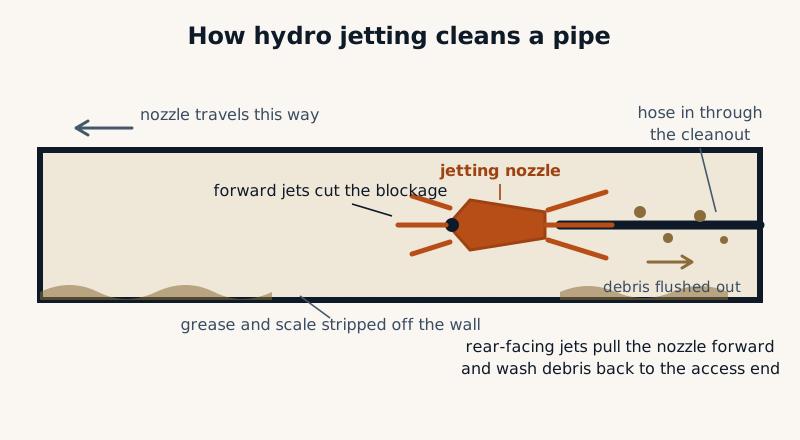
No honest candidacy decision happens from the surface. The line is jetted clean first, because a camera pushed through grease films grease, and then scoped for its full length.
What the pro is building is a profile of the host pipe: its material, its shape, its slope, its damage map, measured in feet from the cleanout. Every candidacy factor that follows is read off that profile.
This sequencing is also the homeowner's protection. Trenchless repair is priced by the foot and sold on its convenience, and the only thing standing between a fair candidacy call and a hopeful one is footage both parties can look at.
If a trenchless quote arrives before a camera has been through your line, the order of operations has been reversed, and the quote is a guess wearing a uniform.
The same run quietly gathers the numbers every quote depends on: total length, depth at both ends, the count of bends, and where the cleanouts sit. Two houses with identical symptoms can receive opposite answers purely because one line is reachable and the other is not.
None of that is visible from the kitchen floor, which is why candidacy opinions offered without a camera run should be filed where they belong, as estimates rather than decisions.
The Yes Conditions
A strong candidate has a host pipe that still holds its round shape along the run, even if it leaks at the joints. Access exists or can be created at both ends of the section being renewed.
The line's bends are the long, sweeping kind that equipment is built to travel, and its connections, the branches joining along the run, are few enough to be reopened cleanly after lining or managed during a bursting pull.
Slope matters as much as shape. A line with honest fall, draining the way it was laid, can be renewed along its path and will drain correctly afterward. The footage also confirms the run's length and depth, which set the staging for either method.
When those conditions line up, candidacy is not a close call, and the conversation moves to choosing between lining and bursting on their merits.

The Honest No's
The most common no is collapse. A pipe that has flattened, caved or lost sections entirely gives a liner nothing to mold against and can stop a bursting head or misdirect it. The second no is severe sag: a deep belly holding water along the run.
Trenchless methods follow the existing path, so renewing a badly sagged line preserves the sag, and a new pipe that ponds water has inherited the original disease in a younger body.
Access can also say no, where neither end of the run can be reached without the very excavation the method exists to avoid, and sharp direction changes or a tangle of connections can close the case on shorter runs. None of these findings are sales resistance.
Each is a physical fact about a specific buried pipe, and each one routes the job to the method that can actually fix it.
Many older lines are not one pipe at all. They are several, joined across decades of repairs: cast iron under the house, clay or fiber pipe in the yard, plastic at the street connection.
Each material takes a liner differently and splits under a bursting head differently, so a method that suits one section can be wrong for the next. The plan has to follow the line as it actually exists, not as the original drawing imagined it.
What A No Actually Means
A no to trenchless is not a no to repair.
The same footage that closed the trenchless door has mapped the line completely, which is exactly what a conventional repair needs: the failed sections located, the depths known, the dig scoped to the damage instead of the whole yard on suspicion.
Often the answer is hybrid, a trenchless renewal for the sound majority of the run and one open excavation at the single collapsed point.
There is also value in hearing the no early. A line that is told no in October, on footage, gets its conventional repair scheduled in dry weather at a planned price.
The same line discovered as a no in an emergency gets the excavation anyway, at the worst moment, with the yard already damaged by the failure. Candidacy is a small, calm question. It deserves to be asked while calm is available.
If your line is a candidate, the choice between the two methods is its own comparison, covered in sewer lining vs pipe bursting, honestly compared.