Drain Cleaning
Single fixtures and whole branch lines cleared with the tool matched to the blockage: a cable for a hard stop, water pressure for a coated pipe.
Learn more →
Nine services, one specialty: getting Bradenton drains and sewer lines cleaned, seen and sound. Hydro jetting leads the list, and the homepage is devoted to it. Everything else divides into three kinds of work: clearing a line out, looking inside it, and rebuilding the parts that have failed.
The cards below give the short version of each service; below them sits the part worth reading before you book anything, a straight comparison of the four core methods, what each one actually does inside your pipe, what happens during the visit, and roughly how long each takes.
Single fixtures and whole branch lines cleared with the tool matched to the blockage: a cable for a hard stop, water pressure for a coated pipe.
Learn more →The one drain that keeps coming back, traced to its real cause, whether that is the trap, a fault in the branch, or roots, and put right.
Learn more →Backups, sewage at the lowest fixtures, a whole house stalled: urgent clearing first and the cause hunt second, on the same visit.
Learn more →Mains and grease-loaded lines for restaurants, rentals and multi-unit buildings, cleaned on an interval instead of on a disaster.
Learn more →A recorded camera ride through your lateral that shows the clogs, cracks and roots, so the next decision comes from footage, not guesses.
Learn more →One damaged stretch fixed on its own: a cracked joint, a root-split section, an offset, located precisely and opened up once.
Learn more →Lining or pipe bursting that gives you a structurally new pipe along the old path, sparing the oak, the drive and the lanai above it.
Learn more →A complete new lateral from house to street, for lines that have failed along their whole length rather than in one place.
Learn more →The corrosion crust stripped off older cast-iron lines to restore their bore, the step that decides between more service and replacement.
Learn more →Homeowners hear four names used almost interchangeably, and they are not interchangeable at all. One method scours, one pokes, one looks, and one rebuilds.
Booking well starts with knowing which job each performs inside the pipe, because the wrong order wastes the visit: a camera pushed through a grease-loaded line films grease, a cable run through a scaled main opens a slot that closes again, and no amount of cleaning repairs a pipe that has cracked apart.
Jetting solves buildup: the grease film in a kitchen main, the scale crust inside older cast iron, the sediment settled in a flat run, the root hairs threading in at the joints.
A nozzle on a high-pressure hose travels the line and its rear-facing jets pull it forward while water strips the walls and flushes everything back to the access point, so the pipe returns to its full bore instead of gaining a temporary hole.
During the visit the crew works from your cleanout, sections at a time, checking flow as they go. A typical single-family main takes about one to two hours including setup; a short branch line is faster.
What jetting cannot do is fix shape: a cracked, offset or collapsed section stays cracked, offset or collapsed, just cleaner.
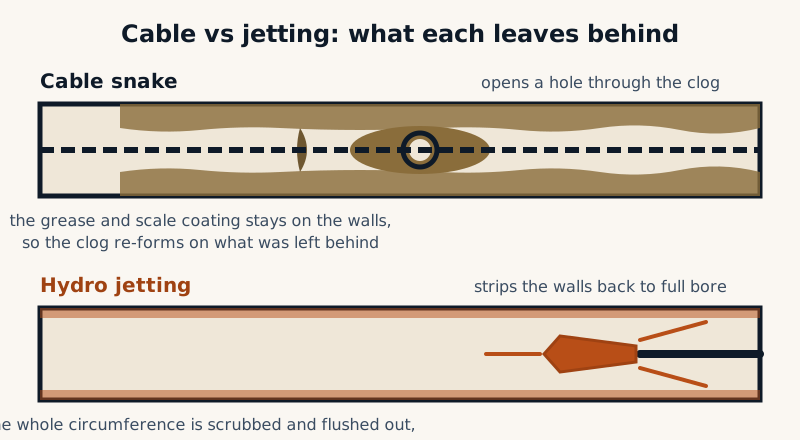
A cable (often called a snake) solves obstruction: one hard plug in one place, a wad of wipes, a toy, a single root knot at a joint. The spinning head bores through or grabs the blockage and the drain runs again, which is exactly what a stopped-up bathroom branch needs.
The visit is compact, often under an hour for a branch line, with the machine run from the fixture or its cleanout.
The limit is built into the method: the cable touches the middle of the pipe, not the walls, so on a grease or scale problem it buys time rather than a cure, and the same clog re-forms on the coating the cable left behind.
The camera solves uncertainty. It is not a repair at all; it is how every later decision gets made honestly.
The waterproof camera travels the lateral from the cleanout while the pro watches the live picture and records it, calling out distances so a fault can be found again from the surface: here the roots, here the crack, here the belly holding water.
Expect roughly half an hour to an hour for a typical house lateral, longer on the long runs out toward the bay. Booked on its own it answers "what is actually wrong"; booked after a jetting, it answers it about pipe instead of about sludge.
Digging solves failure, and it comes in three sizes. A spot repair opens the ground at one located fault, cuts out the bad section and ties in new pipe; once the camera has marked the spot, the digging itself is usually a day or less.
Trenchless work, a liner cured inside the old pipe or a new pipe burst through along its path, renews a whole run from a couple of access pits and commonly wraps up in a day.
A full lateral replacement, house to street, is the largest job on this page: new pipe, proper fall, backfill and surface restoration, typically one to two days for a house.
All three start the same way, with the footage that says which size of rebuild, if any, your line has honestly earned.
Put together, the order almost chooses itself. A line that is loaded gets jetted. A line that is clean gets scoped. A line on film gets a decision: monitor it, repair the one fault, or rebuild the run. And running through all of it is one small asset, your cleanout.
Every method above starts there, crews work faster and cleaner from a yard cleanout than from a pulled toilet, and if your home lacks one, having one fitted while a crew is already on site is the least expensive upgrade in this entire guide.
No. Jetting is the flagship service here because so many Bradenton drains need a full scour rather than a poke, but the right starting point depends on the problem.
A single slow fixture usually starts with straightforward drain cleaning, a whole-house backup starts with a camera, and a known broken pipe may go straight to a repair conversation. The sequence that protects you is clean first if the line is loaded, look second, and only then decide.
Cleaning, jetting and camera work never do. Replacing a sewer lateral, rerouting lines or tying into the city main usually does, and who issues it depends on the address: work inside the city limits goes through the City of Bradenton, while unincorporated addresses are permitted through Manatee County.
Ask any pro you speak with who is pulling the permit for your address before the work starts; a permitted job is an inspected job, and that protects the next owner as much as you.
Often, yes, and it is the smarter way to book. If the kitchen line is slow and the main has a history of root backups, say both when you call.
The professional can jet the main, run the camera while the line is clean, and clear the branch line in the same visit, so you pay for one trip and leave with the full picture instead of a temporary fix.
Call and describe what your drains are doing. The symptoms usually name the right first service, and the professional on the visit can confirm it and explain the next step.
Call (941) 344-0204