
Why Bradenton Is Full Of Cast Iron
Drive the older half of this city and you are driving over cast iron. The postwar building decades, when Bayshore Gardens, Oneco and the west-side streets filled with ranches and bungalows, plumbed those homes with cast-iron drain lines almost as a matter of course.
Iron was the quality material of its era: heavy, quiet, fireproof and expected to outlast the mortgage by generations.
In many ways it has. The same lines are still under those houses, carrying their second and third owners' water. But iron's service life is spent from the inside, invisibly, and the bill for six decades of that spending arrives on a schedule the neighborhoods now share.
Streets of same-age homes tend to meet their sewer decisions in the same seasons, which is why one replacement on a block so often precedes a run of camera inspections.
The buried line is only part of the system these houses carry. The vertical stacks inside the walls are cast iron too, rising from the slab to the roof vent, and they age from the inside as decades of kitchen and laundry water run down them.
A stack rarely announces itself early. It tends to surface as a wall stain or a persistent musty smell, which is why an inspection that only runs the main line tells an incomplete story in a house of this era.
Corrosion Works From The Inside Out
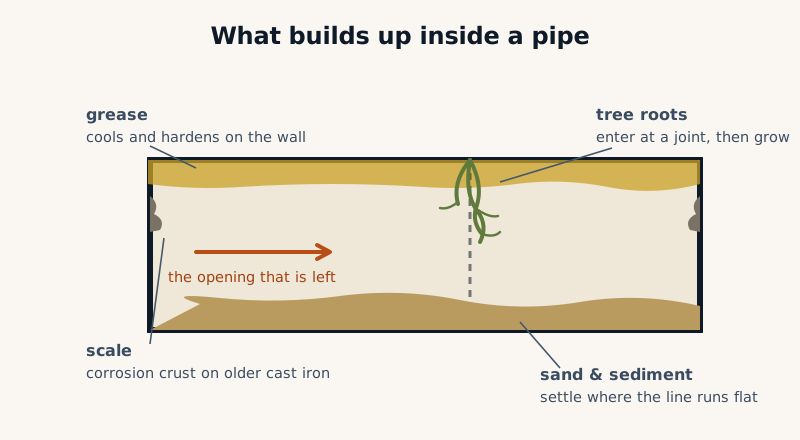
A cast-iron drain corrodes where the water touches it. Wastewater, cleaning chemicals and the gases that form above the waterline attack the interior surface season after season. The first product is scale: a rough, pitted crust that builds on the walls and narrows the bore a little every year.
A four-inch line at sixty can present the camera with an effective opening half that size, lined with a surface that catches everything passing through it.
The second process is quieter and decides the pipe's fate. Along the bottom of a horizontal run, where water and grit travel, corrosion can thin the metal preferentially, a pattern pros call channel rot.
The pipe may look sound from outside and even feel sound, while its floor has worn toward paper. That is the section that eventually cracks, sags or perforates, usually under the house or along the lateral where nobody can see it happen.

What Sixty Years Looks Like On Camera
A camera run through an aging iron line reads like a core sample of its history. The scale shows as rough, orange-brown walls with the bore visibly narrowed. Joints show their age first, with edges crumbled or offset where sections meet. Roots, when they come, come at those joints.
In the worst stretches the camera finds the bottom of the pipe soft, deformed or gone in patches, with soil visible where metal used to be.
Just as usefully, the camera shows what is not wrong. Many sixty-year-old lines are scaled but structurally honest: thick-walled, straight, and entirely capable of years more service once the scale is jetted off and the bore restored.
The footage separates those two fates, the tired pipe from the dying one, and no amount of guessing from the surface can do the same job. Age is the suspicion; the camera is the evidence.
Bradenton's soil adds its own vote. Sand shifts and settles, and a rigid pipe cannot flex along with it, so small movements open joints and drop short sections out of grade. A dropped section holds water and waste permanently, and everything that settles there starts the next clog.
Contractors call it a belly. It is one more reason the decision follows the pipe's measured condition: two lines of identical age, in different soil, can be in entirely different shape.
The Decision The Footage Sets Up
For the sound-but-scaled line, the answer is maintenance with a memory: jet the scale off, file the footage, and let the next inspection, years later, measure the rate of change.
For the line with one failed section, a sectional sewer line repair replaces the bad length and leaves the honest pipe in the ground. For the line failing along its length, replacement or trenchless rehabilitation is the honest spend, made once instead of in installments.
What the footage prevents is the two expensive errors: replacing a line that had a decade left, and cleaning a line that had none.
Bradenton's cast-iron generation is reaching its decision years together, and the owners who come out best treat the decision as an inspection result rather than a sales moment. Get the look, see your own pipe on the screen, and let the metal, not its birthday, make the call.

If your line is already describing itself in slowdowns and gurgles, the companion guide lists the signs of a failing sewer line in the order they usually appear, so you can place your pipe on the timeline before the camera confirms it.
And when the footage shows scale doing the narrowing, there is a middle path between cleaning and replacement: cast-iron pipe descaling strips the corrosion crust off the iron and restores the bore the pipe was built with.