
First: The Small Slowdowns
A failing sewer line almost never starts with a catastrophe.
It starts with drains that are a little slower than they were, spread across the house rather than in one room: the tub that lingers, the toilet that needs a second flush some days, the kitchen sink that empties without its old enthusiasm.
Individually each is easy to blame on the fixture. Together they are the main line narrowing.
The pattern to notice is that the slowness is shared and gradual. A single slow sink is a branch problem, local and small.
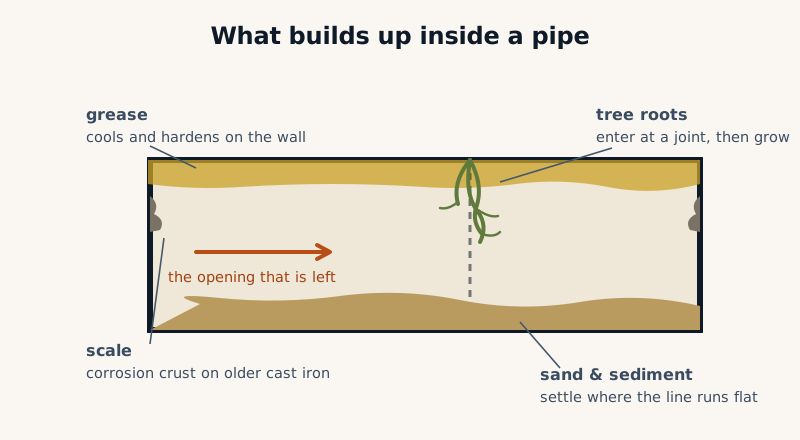
Every drain losing speed over the same season is the shared pipe losing capacity, and at this stage the line is usually still whole: coated, scaled or carrying early roots, but intact and very fixable. This is the least expensive moment in the entire story to act.
Next: Sound And Smell Join In
As the narrowing worsens, the line begins to report itself audibly. Gurgling from a toilet when the tub drains, bubbling in a sink while the washer empties, these are air being pushed backward through traps because water leaving the house is meeting resistance downstream.
A healthy line vents that air silently. A restricted line talks about it.
Smell arrives in the same chapter. Occasional sewer odor near a floor drain, in a little-used bathroom or around the yard above the line means gas or waste is finding paths it should not have.
At this stage the problem may have moved past simple coating: roots occupying real space, a joint beginning to open, a section starting to deform. The camera conversation belongs here, while the line is still describing itself rather than demonstrating itself.
Which fixtures complain carries information too. The lowest drains in the house report a main line problem first, because rising water reaches them before anywhere else: a ground floor tub, a shower stall, a basement floor drain if the house has one.
Upper floor fixtures can keep behaving normally for a surprisingly long time. That is how a failing main hides behind one stubborn downstairs bathroom while the rest of the house seems fine.

Then: The Whole House, And The Yard
The third stage is backups, and they follow the plumbing's gravity: sewage appears first in the lowest fixtures, a ground-floor tub or shower, when other water runs. By now the line's remaining capacity is smaller than ordinary household use at peak moments.
Alongside the backups, the yard starts keeping the line's secrets: a patch of lawn that stays greener, softer or wetter than everything around it, sitting over the pipe's path.
That green patch is the line leaking waste water into the soil, fertilizing and watering one strip of ground. It is also often the moment the failure becomes structural rather than functional: a crack, a separated joint, a section the soil has begun to move into.
The response now is a located sewer line repair conversation, scoped by camera footage, rather than another cleaning, because cleaning cannot close a hole.
The yard offers one more check that costs nothing. After a dry week, compare the soil over the line's path with the soil a few feet away.
Dampness that has no sprinkler or rainfall to explain it, in the same spot, on repeated checks, belongs in the same report as the smells and the sounds. Single observations mislead. The same observation three times is a pattern, and patterns are what inspections are built on.
Last: The Signs That Mean Stop And Call
The final stage needs no interpretation.
Sewage surfacing in the yard, a depression or soft sinkhole forming over the line's path, waste backing into the house despite everything, or a cleanout that spills when opened: the pipe has failed openly, soil may be entering or leaving the line, and the void under the ground can grow.
This is prompt-call territory, and minimizing water use until the visit genuinely limits the damage.
Read backward, the sequence is the lesson. Almost every line that reaches stage four spent months in stages one and two, announcing itself at cleaning prices before it presented at excavation prices.
The homeowners who fare best are not the ones with better pipes; they are the ones who believed the early signs. A slow season for your drains is information. So is a gurgle. The line is talking either way.
Most Bradenton lines giving these warnings are the same vintage and the same material, which is its own part of the story: what sixty years does to a cast-iron sewer line explains why the whole city reads from this same sequence at the same age.