
A Repeat Clog Is A Message, Not Bad Luck
The first time a drain clogs, the cause can be almost anything, including pure chance: a wad of material that met a joint at the wrong angle on the wrong day. The third time the same drain clogs in a season, chance has left the conversation.
A blockage that re-forms in the same place, at a similar interval, is the pipe reporting a condition, and the interval itself is part of the report.
This is why professionals ask how long the last clearing lasted. A drain that ran clear for two years and clogged once is healthy with an event in its past.
A drain that clogs every six weeks is a drain with something growing, coating or sitting inside it, and clearing it a fourth time the same way will produce the same six weeks. The pattern is the diagnosis knocking; the visit should answer it.
The Three Usual Senders
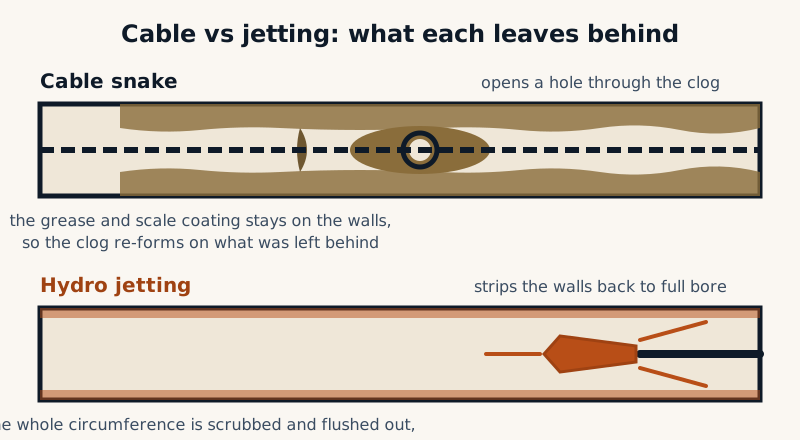
The first sender is the coating. If the original clearing was a cable through a grease or scale problem, the walls kept their film, and re-clogging is simply the film finishing the job it started.
The timescale gives it away: weeks to a few months, faster after heavy kitchen use, and the material that comes out looks like what went in last time, because it is the same process restarting.
The second sender is roots at a joint. A cable cuts the root mass out of the middle of the pipe, but the entry point, a joint gap or hairline crack, stays open, and roots regrow toward the water and nutrients the line carries.
The third sender is shape: a sagging section, called a belly, that holds water permanently. Everything heavy settles in that standing water, clearing after clearing, because the cable cannot lift a pipe back to its slope.
Roots sharpen the point. A cable cuts root masses where it passes, and cut roots respond the way pruned branches do, returning thicker at the cut.
Each visit buys a slightly shorter interval than the one before, which is the classic signature of a root problem being managed rather than solved.
It is also why a camera belongs in this conversation early: the question is no longer how to clear the line, but how much of the joint the roots now own.

What To Track Between Visits
You can hand the professional a far better diagnosis than the drain itself provides. Note which fixtures are affected and whether it is always the same one. Note the interval since the last clearing and whether it is shrinking, because a shortening interval usually means the cause is growing.
Note whether the clog follows anything: heavy rain, a full house of guests, the dishwasher and laundry running together.
Note, too, what the first signs are. A drain that announces itself with gurgling weeks before it stops is describing air being pushed through a narrowing line, which is a main-line story.
A drain that works perfectly until the day it stops dead is describing an obstruction, which is a branch-line story. These details take a minute to write down and they steer the visit toward the right tool from the first minute.
Keep the dates. A simple note of each clearing, what was found, and how long the line behaved turns a frustrating pattern into usable evidence, and it costs nothing but a pen.
Contractors read that history the way mechanics read a service log: the interval, the season, and the fixtures involved usually identify the short list of causes before the truck is even loaded. Homeowners who arrive with the log get a diagnosis. Homeowners without one get another clearing.
The Step That Ends The Guessing
When a drain has told the same story twice, the next step is not a stronger clearing; it is a look.
A camera run through the line shows which of the three senders you own: the coating still on the walls, the roots at their joint, the belly holding its pool of water. Each one has a different correct fix, and none of them is another appointment with the same cable.
That is the point where drain cleaning done as a diagnosis, camera first, method second, earns its keep. The coating gets jetted, the root joint gets repaired or put on a jetting interval, and the belly gets an honest conversation about the pipe's shape.
What ends is the subscription you never signed up for: the same clog, the same visit, the same six weeks, repeating until the pipe is finally asked what is wrong.
A repeat clog is your pipe filing the same report until somebody reads it. For the other half of the story, what the thorough tool actually removes when the walls are the problem, see what hydro jetting removes that snaking leaves behind.