
Two Tools, Two Different Ideas Of Clean
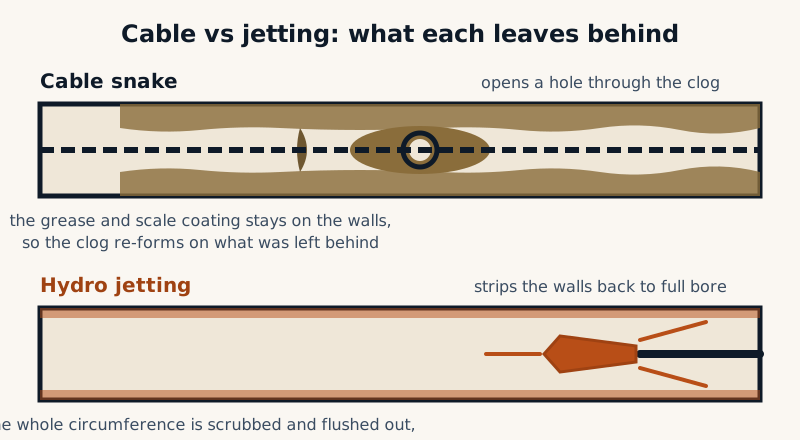
A cable snake is best pictured as a corkscrew on a long spring. The spinning head bores into the blockage, chews a tunnel through it, and sometimes grabs and retrieves the wad that caused it, a clump of hair, a wad of wipes, a root knot at one joint.
When the cable comes out, water runs again, and for a simple obstruction in a single branch line, that is a complete and honest fix.
Jetting starts from a different definition. Instead of asking where the plug is, it asks what condition the whole pipe is in. A nozzle on a high-pressure hose travels the full run, and its jets strip whatever coats the walls, not only the one spot that stopped the flow.
That full-wall cleaning is what the drain cleaning service means when it is done thoroughly, and it is why the two tools, used on the same drain, produce results that last very different lengths of time.
What The Cable Leaves On The Walls
Start with grease. Kitchen lines coat themselves in a film of cooking fat that cools, hardens and narrows the pipe a fraction at a time.
A cable passes through the soft center of that narrowing and never touches the film itself, so the day the cable leaves, the coating that built the clog is still there, ready to catch the next load of residue and start again.
Scale is the second leftover. Inside older cast iron, corrosion builds a rough crust that grabs everything flowing past it, and a cable head rides over the crust rather than removing it.
Root hairs are the third: a cable severs the root mass in the middle of the pipe but leaves the strands anchored at the joint they entered through, and those strands are exactly where regrowth starts.
Soap scum and sediment in low spots complete the list of things a hole through the middle never addresses.
There is a pattern in service records that follows from all of this. Lines that are jetted tend to stay clear longer than the same lines did after repeated snaking, and the difference is not the power of the machine. It is the wall condition the two tools leave behind.
A cable restores flow through a dirty pipe. A jet restores the pipe itself, closer to the condition it was in when it was new, and a clean wall simply takes longer to become a clogged one again.
What The Water Takes Off
A jetting nozzle is built to argue with walls, not plugs. Its forward jet cuts through the blockage ahead of it, and its rear-facing jets angle back against the pipe surface, peeling the grease film, flaking the scale crust and shearing root hairs off at the joint line.
Because the rear jets also pull the nozzle forward, the whole run gets the same treatment, end to end, at a pressure a professional sets for the pipe material in front of them.
Just as important is where the removed material goes. The water flow carries the stripped debris back toward the access point and out of the line, rather than pushing a loosened plug further downstream to catch at the next joint.
A line that has been jetted and then checked by camera shows bare pipe wall for its full length, close to the diameter it had when it was installed, which is the condition a drain needs to stay clear through ordinary use.
The nozzle choice matters as much as the pressure. Rear-facing jets pull the hose forward and do the scouring, while a forward jet on some nozzles punches the initial path through a heavy blockage. Rotating nozzles suit grease and scale, and heavy penetrating heads suit compacted debris.
A pro changes heads as the line talks back through the hose, which is another reason the same machine produces different results in different hands.
When Leaving Something Behind Is Fine
None of this makes the cable the wrong tool. A hair clog in one bathroom branch, a single obstructed fixture, a toy or a cap dropped down a drain: these are obstructions, not coatings, and a cable handles them quickly and completely.
Sending a jetter after every small clog would be more machine than the problem owns, and a good pro will tell you so rather than sell the bigger service.
The honest dividing line is recurrence and reach. One clog, one fixture, one time: cable.
The same line clogging on a schedule, several fixtures slowing together, a main line with a grease or scale history: the problem now lives on the walls, and the tool has to work on the walls.
Choosing between them is a diagnosis, not a preference, and it starts with the symptom pattern you describe on the call.

The short version: a snake removes the plug, jetting removes the plug and the reason it formed.
If your question is less about the tools and more about why your drain keeps needing one of them, the companion guide on why a drain that clogs again after snaking is telling you something reads that pattern properly.